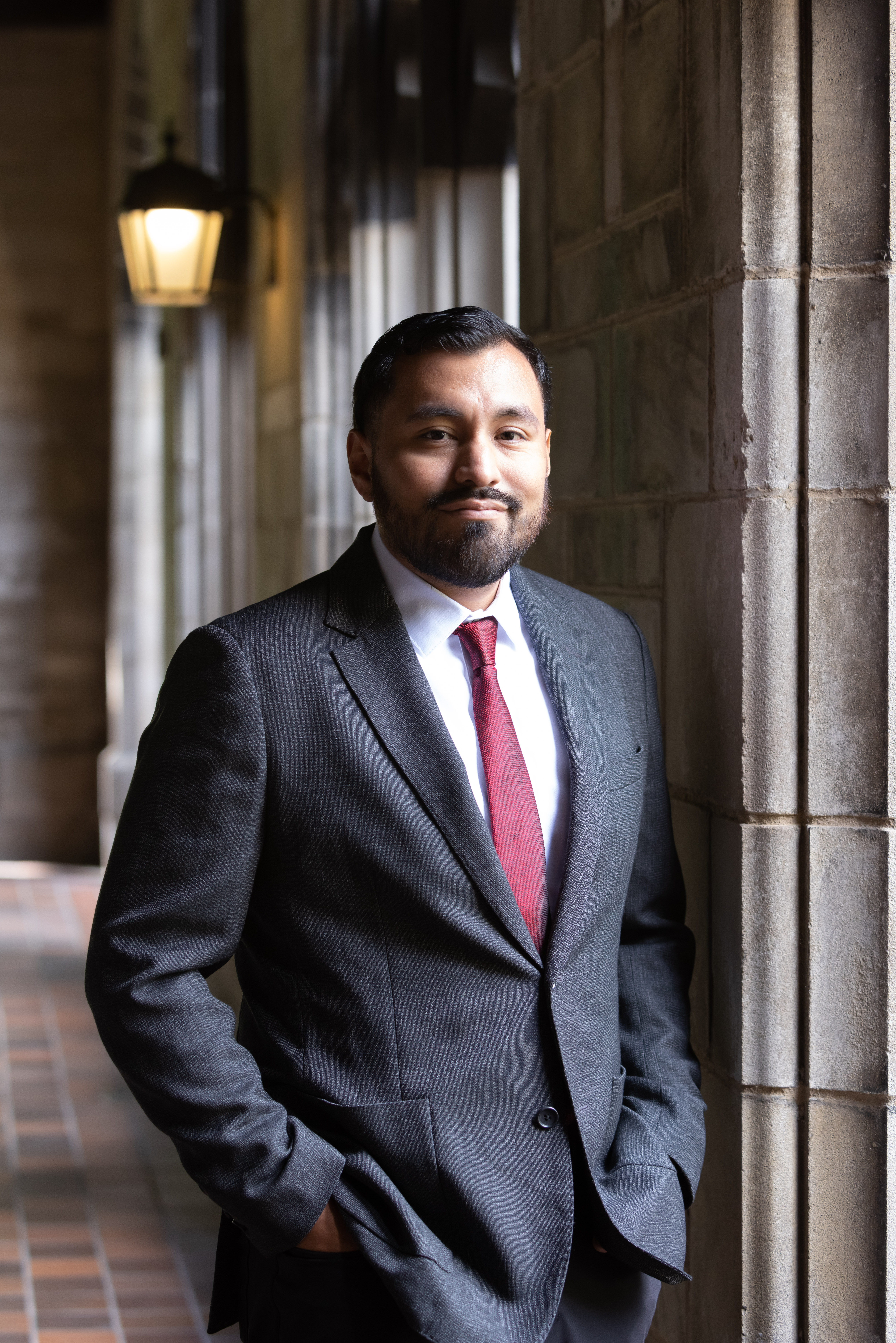
Christopher Campos

5807 South Woodlawn Ave

Chicago, IL 60637

I am an Assistant Professor of Economics and John E. Jeuck Faculty Fellow at the University of Chicago Booth School of Business. I am also a Faculty Research Fellow at the National Bureau of Economic Research (NBER). My research uses a combination of experimental, quasi-experimental, and structural methods to study the economics of education, with an emphasis on how the design of education markets shapes outcomes.

Before pursuing higher education, I served in the United States Marine Corps and served tours in Iraq and Southeast Asia. I received my PhD in Economics from UC Berkeley in 2021 and spent one year as a Postdoctoral Research Associate with the Industrial Relations Section at Princeton University.

Sign up for office hours here.

Email: Christopher.Campos@chicagobooth.edu.

Selected Research

  1. Who Benefits from Remote Schooling? Self-selection and Match Effects
    Bruhn, Jesse, Campos, Christopher, Chyn, Eric, and Tran, Anh
    Revise and Resubmit at the American Economic Review
    We study the distributional effects of remote learning using a novel approach that combines preference data from a conjoint survey experiment with administrative student records. The experimentally derived preference data allow us to account for selection into remote learning while also studying selection patterns and treatment effect heterogeneity. We validate the approach using random variation from school choice lotteries. Our analysis of the average impacts of remote learning finds negative effects on reading (-0.13 SD) and math (-0.14 SD) achievement. Notably, we find evidence of positive learning effects for children whose parents have the strongest demand for remote learning. Parental concerns related to bullying appear to be an important driver of the demand for remote learning. Moreover, we find that across-the-board positive impacts of remote learning on bullying outcomes operate as a compensating differential for negative impacts on learning. Our results suggest that an important subset of students who currently sort into post-pandemic remote learning benefit from expanded choice.
    Who Benefits from Remote Schooling? Self-selection and Match Effects
  2. Social Interactions, Information, and Preferences for Schools: Experimental Evidence from Los Angeles
    Campos, Christopher
    Revise and Resubmit at the Journal of Political Economy
    This paper measures parents’ beliefs about school and peer quality, how information about school and peer quality affects parents’ school choices, and how social interactions mediate these effects. In a field experiment, parents were randomly given information on school quality and peer quality, with varying proximity to other parents who received similar information. Results show that parents typically underestimate school quality and overestimate peer quality. When both parents and their neighbors received information, preferences shifted toward higher value-added schools. These findings suggest substantial information spillovers, leading to increased enrollment in effective schools. Enrollment in more effective schools leads to improved socio-emotional outcomes not captured by standardized exams. This evidence suggests that the intervention did more than alter educational pathways; it also played a critical role in shaping important developmental aspects of students’ lives.
    Social Interactions, Information, and Preferences for Schools: Experimental Evidence from Los Angeles
  3. Who Chooses and Who Benefits? The Design of Public School Choice Systems
    Campos, Christopher, Chyn, Eric, Bruhn, Jesse, and Vazquez, Antonia
    Under Review
    Public school choice has evolved rapidly in the past two decades, as districts roll out new magnet, dual-language, and themed programs to broaden educational opportunity. We use newly collected national data to document that opt-in (voluntary) systems: (i) are the modal design; (ii) are harder to navigate; and (iii) have participation that is concentrated among more advantaged students. These facts suggest a striking inconsistency: districts have largely adopted centralized assignment algorithms to broaden access, but most rely on optional participation that fragments public education. We study the implications of this design choice in the Los Angeles Unified School District, the largest opt-in system in the country, combining two decades of administrative data, randomized lotteries, and quasi-experimental expansions in access. Participation is highly selective, consistent with national evidence, and lottery estimates suggest that the students with the lowest demand for choice schools are the ones who gain the most from attending. Opt-in participation therefore embeds a selection mechanism that screens out high-return students and leaves many effective programs with unused capacity. To evaluate system-level implications, we estimate a structural model linking applications, enrollment, and achievement. Choice schools are vertically differentiated and generate meaningful gains, but the opt-in participation rule—through high application costs and negative selection on gains—prevents these benefits from reaching the students who need them most. Counterfactual simulations make the design stakes clear: information and travel-cost reductions have limited effects, whereas reforms that change the participation architecture eliminate core inefficiencies and deliver the largest district-wide achievement gains. These results underscore that system design—not school effectiveness alone—shapes who benefits from public school choice and to what extent.
    Who Chooses and Who Benefits? The Design of Public School Choice Systems
  4. AI Diffusion Gaps: Unequal Integration of AI Across K-12 Schools
    Campos, Christopher, and Singleton, John
    Under Review
    Although use of generative AI tools has quickly become widespread in education settings, emerging evidence suggests that effects on learning will depend on how that use is supported and guided. This paper reports findings from an original national survey of K–12 school principals designed to measure institutional integration of AI in schools through policies, teacher training, guidance for student use, leadership engagement, and the availability of AI-enabled tools. We find that AI use has spread rapidly across schools, largely as a productivity aid. Students mainly use AI for homework help and writing, while educators primarily use it for lesson planning and administrative tasks. The development of teacher training, guidance, and school policies has lagged adoption. We next document two diffusion gaps across schools: First, lower AI integration is associated with a higher share of disadvantaged students (a one standard deviation increase in disadvantage is associated with a 0.07-0.11σlower score on an index of AI integration); Second, private and charter schools score 0.23-0.44σlower on the AI integration index than traditional public schools. Although several surveyed school-level factors strongly predict AI integration, they do little to explain these gaps. Differences in district size account for roughly one-third of the disadvantage gap between public schools. These findings suggest that the factors associated with greater AI integration differ from those needed to narrow disparities in how schools support and guide AI use.
    AI Diffusion Gaps: Unequal Integration of AI Across K-12 Schools